


Chevy Fluid Services Explained: Transmission, Coolant, Brake Fluid and More
Chevy Fluid Services Explained: Transmission, Coolant and Brake Fluid for Plainfield, IL Drivers
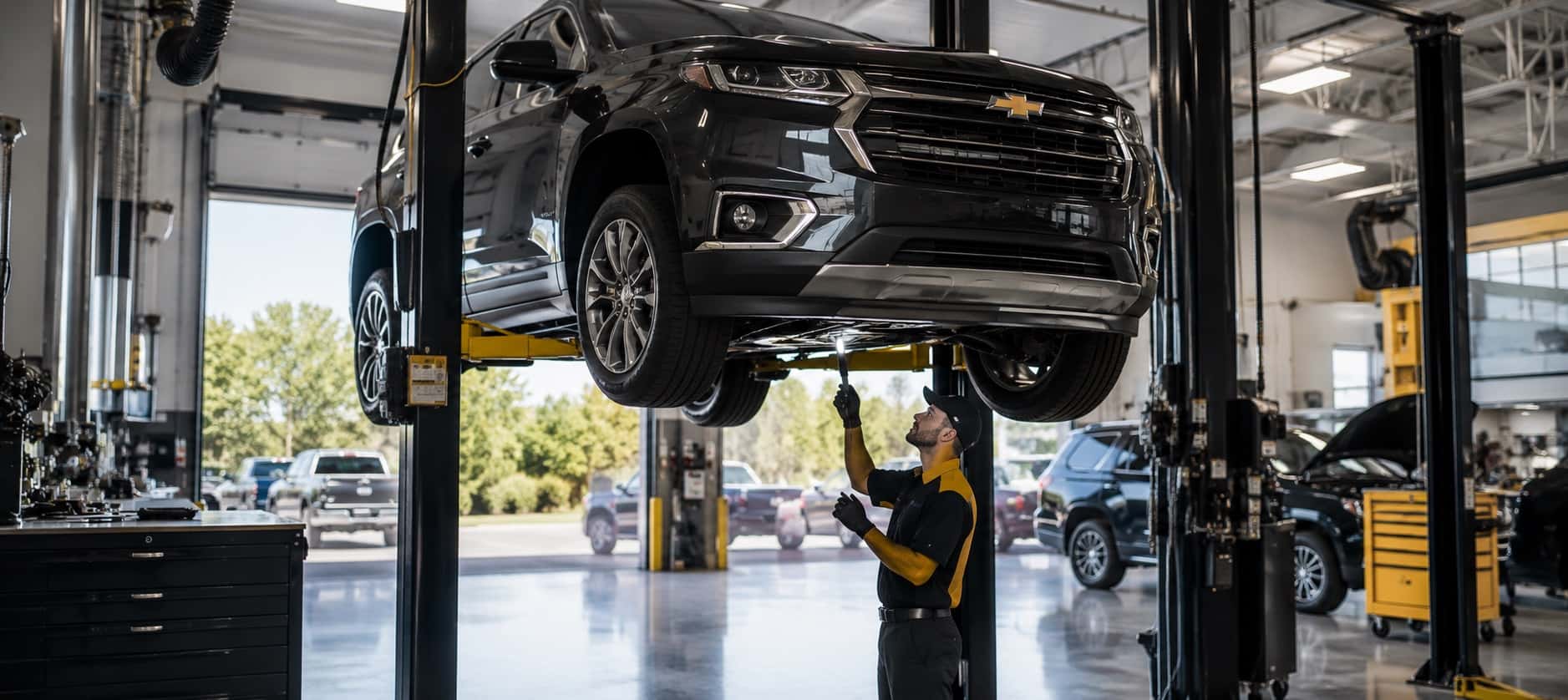
Oil changes get all the attention. Everyone knows the interval, everyone has an opinion about it, and every quick-lube sign in Plainfield advertises it. Meanwhile the other five or six fluids in your Chevrolet quietly do equally critical work and get almost no thought until something goes wrong.
That imbalance is expensive. A neglected transmission fluid service is a fraction of the cost of a transmission. Old brake fluid compromises stopping performance in exactly the conditions where you need it most. Degraded coolant can take out a water pump, a thermostat, or a head gasket.
This guide covers what each fluid in your Chevy actually does, the signs it needs attention, and roughly when each one comes due. Intervals vary by model, engine and driving conditions, so confirm the specifics for your vehicle in the owner’s manual or with the service team at Webb Chevy Plainfield.
Why do fluids need replacing if they are not leaking?
Because fluids degrade chemically through heat, pressure, oxidation and contamination. A full reservoir of worn-out fluid provides far less protection than the level suggests.
Every fluid in your vehicle carries additives that do the real work: detergents, friction modifiers, corrosion inhibitors, anti-foaming agents. Those additives deplete on a schedule set by heat and use, not by leakage.
This is why level checks alone are insufficient. A transmission can be perfectly full of fluid that has lost its friction properties, and the only way to know is to evaluate condition rather than quantity.
When does Chevy transmission fluid need service?
Interval varies significantly by transmission and driving conditions, commonly falling somewhere between 45,000 and 100,000 miles. Towing, heat and stop-and-go traffic all shorten it.
Transmission fluid is hydraulic fluid, coolant and lubricant simultaneously. It transmits pressure to operate clutches, carries heat away, and protects gears and bearings. Heat is its primary enemy, and heat is what stop-and-go traffic and towing produce.
Signs worth attention:
- Delayed or harsh engagement when shifting into drive or reverse
- Shifts that feel abrupt, slurred or indecisive
- Shuddering under light acceleration
- Fluid that has darkened substantially or smells burnt
Some newer transmissions use fluid described as long-life, which does not mean lifetime. It means a long interval, and severe-duty use still shortens it. If you tow with a Silverado or Traverse, ask specifically about the towing schedule rather than the standard one.
What does engine coolant do, and when should it be replaced?
Coolant manages engine temperature, prevents freezing, and inhibits internal corrosion. Modern long-life coolant commonly runs 100,000 miles or more, but condition should be checked well before that.
The corrosion-inhibition role is the one drivers forget. As those inhibitors deplete, the coolant becomes progressively more corrosive to the aluminum, steel and gasket materials it circulates through. That is how a coolant service that was deferred turns into a water pump or heater core replacement.
The freeze-protection function is not academic in Plainfield. Coolant that has been topped off repeatedly with plain water has a higher freezing point than it should, and a freeze event can crack a block.
- Temperature gauge reading higher than its normal position
- Sweet smell after driving, which indicates a leak
- Visible rust or discoloration, or floating debris in the reservoir
- Repeatedly needing to add coolant
Why does brake fluid need periodic replacement?
Brake fluid is hygroscopic, meaning it absorbs moisture from the air over time. Water lowers its boiling point and corrodes brake system components from the inside.
This is the fluid service drivers most often skip and least often understand. Brake fluid absorbs atmospheric moisture through hoses and seals even in a sealed system. As water content rises, two things happen: the fluid’s boiling point falls, and internal corrosion begins.
A lower boiling point matters under sustained braking, where heat transfers into the fluid. If it boils, vapor forms, and vapor compresses in a way liquid does not. The pedal goes soft precisely when you need it firm.
Brake fluid is typically evaluated by time and moisture content rather than mileage, often in the range of two to three years. It is tested with a moisture meter during inspection, which makes it one of the easier services to time correctly.
Does my Chevy have power steering fluid?
It depends. Many newer Chevrolet models use electric power steering with no fluid at all, while older hydraulic systems have a reservoir that requires periodic inspection.
Electric power steering has become widespread across the Chevrolet lineup, which removes this maintenance item entirely on many current vehicles. If your model uses a hydraulic system, the fluid should be checked for level and condition.
Symptoms of a hydraulic system needing attention include a whine that changes with steering input, heavier effort at low speed, and visible fluid darkening. Whether your specific vehicle has a hydraulic system is worth confirming rather than assuming, since it varies by model and model year.
What about differential and transfer case fluid?
Four-wheel-drive and all-wheel-drive Chevrolet models have additional gear oil reservoirs that require periodic service, and towing shortens those intervals considerably.
If you drive a Silverado, Colorado, Tahoe, Suburban or an all-wheel-drive crossover, there are gear oil reservoirs beyond the transmission that need attention.
- Front and rear differential fluid on four-wheel-drive trucks
- Transfer case fluid on four-wheel-drive systems
- Rear differential fluid on rear-wheel-drive vehicles
These intervals are heavily condition-dependent. Regular towing, heavy hauling, or frequent four-wheel-drive use can cut them substantially compared to a vehicle used for commuting. Ask for the severe-duty figures if that describes your use.
What symptoms suggest a fluid problem rather than something else?
Changes in how the vehicle shifts, stops, steers or holds temperature are the primary clues, along with any new fluid spots under the vehicle.
Fluid problems announce themselves through changes in feel, and drivers who have owned a vehicle for years are well positioned to notice them.
- Shifting changes: transmission fluid
- Soft or long brake pedal: brake fluid or a hydraulic issue
- Temperature gauge climbing: coolant
- Steering effort or noise: hydraulic steering fluid, if equipped
- Whine or hum that varies with speed: differential or transfer case
Fluid color under the vehicle is a useful clue: coolant is typically orange or green, transmission fluid red, engine oil amber to black, brake fluid clear to light brown.
Does it matter which fluid is used?
Yes, substantially. GM specifies particular fluid formulations for its transmissions, cooling systems and differentials, and substitutes can cause real damage.
Fluid specification is not brand loyalty. Modern automatic transmissions are engineered around the friction characteristics of a specific fluid, and using the wrong one can produce shift quality problems and accelerated internal wear. GM’s long-life coolant uses a particular inhibitor chemistry that is not interchangeable with other formulations.
Servicing at Webb Chevy Plainfield means the fluids used match GM specification for your VIN, which removes the guesswork from a category where guessing is expensive.
Can fluid services be combined into one visit?
Often yes, and it usually saves labor time. Ask your advisor which services can share a lift visit and which should be sequenced separately.
Several fluid services access the vehicle from the same position, so combining them can reduce total labor compared to separate appointments. A transmission service and a differential service on a truck are a natural pairing.
That said, bundling everything at once is not always the right call. If several fluids are approaching their intervals at different rates, spreading the work keeps your maintenance spending predictable. The service team at Webb Chevy Plainfield can lay out what is due now against what is due within the next 10,000 miles and help you sequence it.
Chevy Fluid Services Overview
| Fluid | Function and General Timing |
|---|---|
| Engine oil | Lubrication and cooling; the most frequent service interval |
| Transmission fluid | Hydraulic pressure, cooling, lubrication; commonly 45K-100K, shorter with towing |
| Engine coolant | Temperature control, freeze protection, corrosion inhibition; often 100K+ |
| Brake fluid | Hydraulic force transfer; typically evaluated every 2-3 years by moisture content |
| Power steering fluid | Hydraulic steering assist; absent on models with electric steering |
| Differential fluid | Gear lubrication; interval shortens significantly with towing |
| Transfer case fluid | Four-wheel-drive gear lubrication; condition-dependent interval |
How to Verify Which Fluid Services Your Chevy Needs
- Check your odometer and note your current mileage.
- Open the maintenance schedule in your owner’s manual and find the fluid service intervals for your model.
- Determine whether you drive under severe conditions such as towing, heavy loads or constant stop-and-go traffic.
- Review your service records for the last time each fluid was serviced.
- Note any symptoms: shift quality changes, pedal feel, temperature readings or new noises.
- Schedule an appointment at Webb Chevy Plainfield and ask for a fluid condition assessment.
- Ask which services can be combined on one visit and which are better sequenced across two.
Key Takeaways
- Fluids degrade chemically through heat and use, so a full reservoir can still hold worn-out fluid.
- Transmission fluid intervals vary widely, and long-life fluid does not mean lifetime fluid.
- Coolant prevents internal corrosion, which is why deferring it can cost a water pump.
- Brake fluid absorbs moisture over time, lowering its boiling point and corroding components from inside.
- Many current Chevrolet models use electric power steering and have no steering fluid at all.
- Four-wheel-drive and towing use add differential and transfer case services on shorter intervals.
- GM-specified fluids are engineered for specific systems; substitutes can cause real damage.
Frequently Asked Questions
How often should Chevy transmission fluid be changed?
The interval varies considerably by transmission type and driving conditions, commonly falling somewhere between 45,000 and 100,000 miles. Towing, hauling and heavy stop-and-go driving all shorten it. Your owner’s manual lists the schedule for your specific vehicle, including a severe-duty interval if one applies.
Is lifetime transmission fluid really lifetime?
Fluid described as long-life means an extended service interval, not an absence of one. Heat degrades transmission fluid regardless of the label, and severe-duty use accelerates that. If you tow or drive in heavy traffic regularly, ask specifically about the severe-duty interval for your transmission.
Why does brake fluid need to be replaced if the level is fine?
Brake fluid absorbs moisture from the air over time, even in a sealed system. Rising water content lowers the fluid’s boiling point, which can cause a soft pedal under sustained braking, and promotes internal corrosion. It is typically evaluated by moisture content and time in service rather than by level.
What color is a coolant leak versus a transmission leak?
Coolant is usually orange or green and has a distinctly sweet smell. Transmission fluid is typically red. Engine oil ranges from amber to black, and brake fluid is clear to light brown. Noting the color and location of a spot under your vehicle helps narrow down the source before you bring it in.
Can I use any brand of coolant in my Chevrolet?
No. GM specifies a particular long-life coolant chemistry, and its corrosion inhibitors are not interchangeable with other formulations. Mixing incompatible coolants can reduce corrosion protection and cause gelling. Servicing at Webb Chevy Plainfield ensures the fluid matches GM specification for your vehicle.
Not sure which fluids are due?
The service team at Webb Chevy Plainfield can assess fluid condition against your mileage and driving habits, then tell you what needs doing now and what can wait.
0 comment(s) so far on Chevy Fluid Services Explained: Transmission, Coolant, Brake Fluid and More