


2027 Bolt EV Real-World Range and Charging for Plainfield and Will County
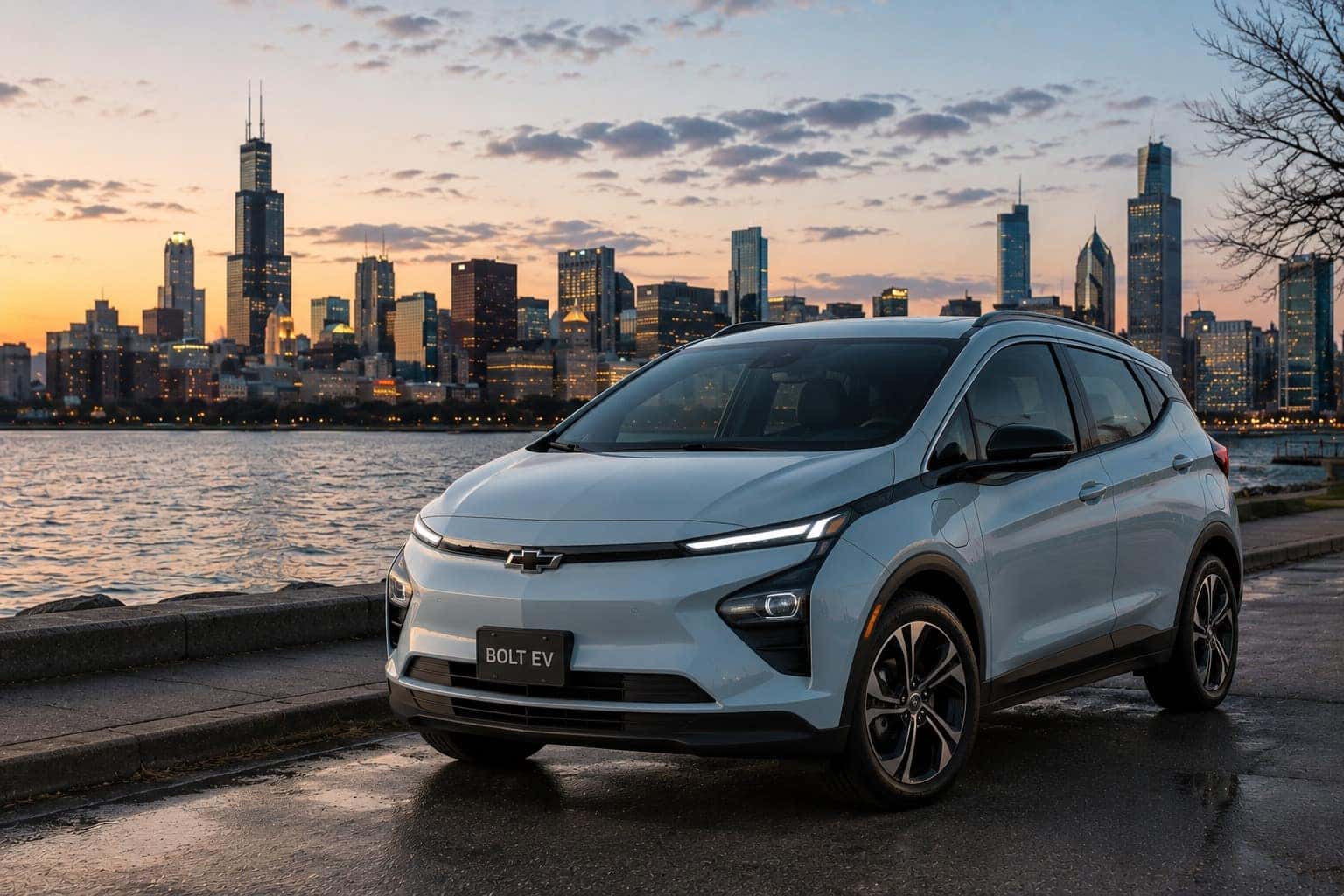
Range & Charging Guide
2027 Bolt EV Real-World Range and Charging for Plainfield and Will County
What 255 miles of GM-estimated range actually means on a commute from Plainfield to downtown Chicago on I-55, and how 150 kW DC fast charging plus a NACS port changes the road-trip equation.
Quick Answer
The 2027 Bolt EV delivers a GM-estimated 255 miles per charge from its 65 kWh LFP battery. Real-world Plainfield range: 240 to 255 miles in moderate weather, 180 to 210 miles in Will County winter. DC fast charging at 150 kW adds significant range in about 30 minutes (10 to 80 percent). Native NACS port unlocks the Tesla Supercharger network without an adapter. Level 2 home charging refills overnight in roughly 8 hours.
The 255-mile GM-estimated range explained
GM-estimated 255 miles is the published range on the 2027 Bolt EV. That number applies to both LT and RS trims at full charge in moderate temperatures (roughly 60 to 80 degrees Fahrenheit), at sustained typical speeds, with no aggressive HVAC use. EPA certified range will come from the agency separately and may differ slightly from the GM estimate.
Real-world Plainfield range varies based on three factors: temperature, speed, and HVAC use. Hot summer days with the AC running full-time will cost you 10 to 20 miles of range. Cold winter days below 20 degrees Fahrenheit will cost 50 to 70 miles or more. Highway-dominant driving at 70+ mph on I-55 or I-80 costs more than mixed Plainfield/Naperville city/suburban driving thanks to wind drag overpowering regenerative braking.
Real-world range expectations by season
| Conditions | Realistic Range |
|---|---|
| 60-80°F, mixed driving, normal HVAC | 240-255 mi |
| 40-60°F, mixed driving | 225-245 mi |
| 20-40°F, mixed driving | 210-230 mi |
| 0-20°F, mixed driving | 180-210 mi |
| Below 0°F (deep freeze) | 155-180 mi |
| Highway 70+ mph, AC on, summer | 210-225 mi |
For a typical Plainfield commuter driving 40 to 60 miles a day (Plainfield to downtown Chicago is roughly 40 miles each way on I-55), even the worst-case Will County January range still covers daily driving with margin to spare. You’d plug in at home overnight and start each day at or near 100 percent.
Common Plainfield-area trips on a single charge
| Trip | Round Trip | Single Charge? |
|---|---|---|
| Plainfield to downtown Chicago and back | ~80 mi | Yes, many times |
| Plainfield to O’Hare and back | ~80 mi | Yes, many times |
| Plainfield to Joliet/Naperville errands | ~30 mi | Yes, many times |
| Plainfield to Milwaukee and back | ~190 mi | Yes (summer) |
| Plainfield to Springfield IL | ~370 mi RT | 1 charging stop |
| Plainfield to St. Louis | ~580 mi RT | 2 charging stops |
| Plainfield to Indianapolis | ~370 mi RT | 1 charging stop |
DC fast charging at 150 kW: what 30 minutes gets you
The 2027 Bolt EV charges at up to 150 kW on a DC fast charger. That’s over 2.5 times faster than the original Bolt’s 55 kW peak. Real-world translation: a 10-to-80-percent fast charge takes approximately 30 minutes at a 150 kW station, adding roughly 175 miles of range in that window. From 0 to 80 percent takes a bit longer, closer to 35 to 45 minutes depending on starting battery temperature.
Charging slows down above 80 percent. This is normal LFP battery management and protects long-term battery health. For road trips, the best strategy is 10-to-80-percent fast charges and stopping more often, rather than waiting for a full 100-percent charge at each stop.
The NACS advantage for Will County drivers
The 2027 Bolt EV ships with a native NACS (North American Charging Standard) port. That’s the Tesla connector design, now officially standardized for North American EVs going forward. The practical advantage: you plug directly into Tesla Supercharger stations without an adapter.
For Plainfield, Naperville, and Will County buyers, the Tesla Supercharger network expands the usable DC fast charging map dramatically. Tesla has stations along all major I-55, I-80, I-355, and I-294 routes around the metro area, plus most state highways outbound toward Indianapolis, St. Louis, and Springfield. The network is generally considered the most reliable and well-trafficked DC fast charging network in North America.
The 2027 Bolt EV can also still use CCS-style chargers (Electrify America, EVgo, ChargePoint) with the included adapter. You’re not locked into Tesla. You just gain access to the Tesla network on top of everything else.
From Our Plainfield EV Specialist
First-time EV buyers from Plainfield, Joliet, Naperville, and Bolingbrook almost always overestimate how often they’ll DC fast charge. For 95 percent of trips, Level 2 home charging is the only charging you’ll do. DC fast charging is for road trips and unusual days. If your daily commute is under 80 miles round-trip and you can plug in at home overnight, you’ll likely visit a DC fast charger less than once a month.
Level 2 home charging is the real daily story
A Level 2 home charger (240V, typically 30 to 50 amps) is the right setup for most Bolt EV owners. Expect to add 30 to 35 miles of range per hour, so a fully drained battery refills in about 8 hours overnight. Plug in when you get home from work, wake up with a full battery, drive 200+ miles the next day with margin to spare.
Level 1 (a standard 120V household outlet) works in a pinch but adds only 3 to 4 miles per hour. From a fully drained battery, that’s roughly 70 hours to fill. For light-duty owners with under-30-mile daily commutes who never road trip, Level 1 can work, but Level 2 is the strongly recommended setup for the typical Plainfield-area driver who runs to Naperville, Joliet, and downtown regularly.
How to maximize real-world range
- Pre-condition while plugged in. Use the myChevrolet app to warm the cabin and battery before you unplug. This recovers a meaningful chunk of cold-weather range loss because the energy comes from your wall, not your battery.
- Don’t speed. Cruising at 65 mph instead of 75 mph can add 15 to 25 miles of usable range on a long trip. Wind drag at higher speeds is the single biggest controllable factor.
- Use Eco mode and one-pedal driving. One-pedal driving captures more energy through regenerative braking and reduces wear on the friction brakes.
- Keep tire pressure correct. Under-inflated tires cost real range. Check monthly, especially in winter when pressures drop.
- Charge to 80 percent for daily use. For routine charging, keep the battery between 20 and 80 percent. Charge to 100 percent only before long trips.
Frequently asked questions
Is the 255-mile range realistic?
In moderate Will County weather (60-80 degrees) on mixed driving, yes. In winter, expect 30 to 40 percent less. In summer with AC running, expect about 10 to 15 miles less than the GM estimate.
Do I need to install a home charger?
Strongly recommended. Level 2 home charging is faster, cheaper per mile than DC fast charging, and means you start every day with a full battery. Budget $500 to $800 for the charger unit plus $300 to $1,500 for electrical installation.
Can I use the Tesla Supercharger network?
Yes, natively. The 2027 Bolt EV’s NACS port plugs directly into Tesla Superchargers with no adapter needed. This is a major upgrade from the original Bolt, which used CCS and could not access the Tesla network at all.
How long does a fast charge from 10 to 80 percent take?
Approximately 30 minutes at a 150 kW DC fast charger. That window adds roughly 175 miles of range. Charging slows down above 80 percent to protect the battery, so the 10-to-80-percent window is the most efficient road-trip stop.
What if my apartment doesn’t have charging?
EV ownership is harder without home charging, but it’s possible if there’s a workplace charger or public Level 2 charging nearby. Speak with our EV specialist before purchase to map out your specific charging plan. For some apartment-only buyers, the Bolt EV may not be the right fit and a non-EV may be a better match.
Talk to our EV specialist about your charging setup
0 comment(s) so far on 2027 Bolt EV Real-World Range and Charging for Plainfield and Will County